Whether you're just starting your vinyl collection or have been spinning for years, the right turntable makes all the difference. We've selected the best options for every budget.
Discover our selection of turntables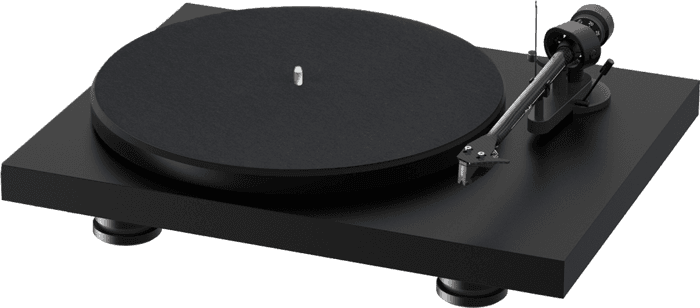
5.0
Average of 1 reviews
1
0
0
0
0
Whether a review is positive, negative, or neutral, we always publish it. However, we screen every review to ensure it is authentic and free of profanity. These checks happen automatically, though a human occasionally steps in. We never pay for reviews.
In "Palace of Marvels," Schmickler once again showcases his prowess in contemporary computer music, following the impressive "Altars of Science" from 2007. While the latter was a thrilling composition brimming with intense tones and masterfully crafted sweeps, "Palace of Marvels" explores a different facet of Schmickler's phenomenological approach to music. This album delves into the concept of the Shepard tone, discovered by Roger Shepard in the 1960s, which creates an auditory illusion of a tone that perpetually rises or falls in pitch without ever seeming to reach a higher or lower point. The Editions Mego website sheds light on the album's title, revealing that the "Palace of Marvels" is a concept from an obscure essay by the renowned philosopher and mathematician Leibniz. He used the term to describe "a perfect political organization, designed so that the master of the house can hear and see everything happening within the premises without being noticed by his subjects." As noted on the website, Leibniz's essay echoes in Foucault's work on surveillance, governmentality, and his famous discussion of Jeremy Bentham's 'Pantopticon'. A nod to Attali's work on noise and political economy further ties the Palace of Marvels to political themes, since "[l]istening in on, ordering, transmitting, and recording noise are at the heart of the modern State." While this might not resonate with everyone, I found that this release doesn't suffer from an excess of theory or an overly intellectual preoccupation (though I must admit my familiarity with the aforementioned authors). Throughout the album, Schmickler enhances the Shepard tone with arpeggios and occasional rhythmic structures (though nothing conventional), resulting in a deeply intricate listening experience (evoking more Kafkaesque dimensions of surveillance and control, but I digress). The Shepard tone is central to this work, representing a form of 'non-occurrence' in the listener's experience. It prompts questions about auditory perception and the socio-political structures that shape our experiences. In essence, how do perceiving subjects engage with political economies that organize (or perhaps 'stratify') experience? To conclude, "Palace of Marvels" intertwines cognitive studies of sound perception with the socio-economic aspects of auditory experiences. For those uninterested or oblivious to these dimensions, it's not an issue: Schmickler's work invites listeners to explore their own perception of pitch, rhythm, and sound. A truly remarkable piece that has deepened my admiration for this captivating composer. A final note on the different formats: the vinyl version of "Palace of Marvels" includes an extended version of the track "Mystery Bouffe" and is highly recommended for vinyl enthusiasts. Two thick slabs of vinyl and excellent mastering left me thoroughly satisfied.
We don't have a live price right now, but stock fluctuates daily. You can check for hidden stock on Amazon directly, or let us alert you as soon as it is available.